课文练习
共 25 题,分 8 部分:
- A 课文理解 · 第1–2题:根据课文《草船借箭》,选出正确的答案。(2 题)
- B 课文理解 · 第3题:根据“草船借箭”的过程,填一填。(1 题)
- C 课文理解 · 第4题:试写出你的看法。(1 题)
- D 构成词语、近似字:从括号里选出正确的字,填在横线上。(6 题)
- E 多音字:选出句中粗体字的正确读音。(4 题)
- F 成语:哪一句画线的成语用得正确?(4 题)
- G “啊”的音变:根据“啊”的音变,在括号内填写正确的读音(ya 或 nga)。(6 题)
- H 书写:根据图意,写一个段落描写阿杰的动作和神态。(1 题)
按正确的答案。
把答案打在格子里。
写作:把答案打在框里(也可以写在纸上),再对照范文,勾出你做到的要点。
A课文理解 · 第1–2题:根据课文《草船借箭》,选出正确的答案。第 1–2 题(共 2 题)
(1) 借二十艘船给他
(2) 千万不能让周瑜知道这件事
(3) 派五百名士兵到江边搬箭
fakta cerita = 课文事实
Soalan pertama bertanya tempoh asal yang diberikan oleh Zhou Yu sebelum Zhuge Liang sendiri memendekkannya. Soalan kedua bertanya permintaan Zhuge Liang kepada Lu Su. Ingat bahawa arahan menghantar lima ratus askar untuk mengangkut anak panah diberikan kepada Zhou Yu, bukan kepada Lu Su.
Contoh: Zhuge Liang meminjam dua puluh buah perahu dan meminta Lu Su merahsiakannya.
Awas: Jangan keliru antara sepuluh hari yang diminta Zhou Yu dengan tiga hari yang dijanjikan Zhuge Liang.
story facts = 课文事实
The first question asks for the deadline Zhou Yu set before Zhuge Liang shortened it himself. The second asks what Zhuge Liang requested from Lu Su. Remember that the order to send five hundred soldiers to carry the arrows was given to Zhou Yu, not to Lu Su.
Example: Zhuge Liang borrows twenty boats and asks Lu Su to keep it secret.
Watch out: Do not mix up the ten days Zhou Yu asked for with the three days Zhuge Liang promised.
B课文理解 · 第3题:根据“草船借箭”的过程,填一填。第 1 题(共 1 题)
可以写汉字,也可以写阿拉伯数字。
nombor dalam cerita = 故事里的数字
Ketiga-tiga tempat kosong memerlukan satu nombor daripada cerita. Zhuge Liang menjemput Lu Su ke perahu pada waktu syif malam keempat hari ketiga. Cao Cao memanggil enam ribu pemanah untuk membantu tentera laut. Apabila perahu kembali, Zhou Yu sudah menghantar lima ratus askar ke tepi sungai.
Contoh: sì gēng ialah syif malam keempat, kira-kira jam satu hingga tiga pagi.
Awas: Baca perkataan selepas tempat kosong: qiān ialah ribu dan bǎi ialah ratus.
numbers in the story = 故事里的数字
All three blanks need one number from the story. Zhuge Liang invites Lu Su onto the boat in the fourth watch of the third night. Cao Cao calls up six thousand archers to support his navy. When the boats return, Zhou Yu has already sent five hundred soldiers to the riverbank.
Example: sì gēng is the fourth night watch, roughly one to three in the morning.
Watch out: Read the word after each blank: qiān means thousand and bǎi means hundred.
C课文理解 · 第4题:试写出你的看法。第 1 题(共 1 题)
字数: 约 40–60 字
andaian = 假设
Soalan ini meminta anda membayangkan keadaan jika Lu Su tidak menyimpan rahsia. Ingat sifat Zhou Yu yang cemburu dan mahu menyusahkan Zhuge Liang. Terangkan apa yang mungkin dilakukan oleh Zhou Yu, dan bagaimana rancangan meminjam anak panah akan gagal.
Contoh: Zhou Yu mungkin enggan meminjamkan perahu, jadi rancangan itu gagal.
Awas: Jawapan mesti berdasarkan sifat watak dalam cerita, bukan rekaan yang tiada kaitan.
supposition = 假设
This question asks you to imagine what would happen if Lu Su had not kept the secret. Remember that Zhou Yu is jealous and wants Zhuge Liang to fail. Explain what Zhou Yu might do and how the plan to borrow the arrows could fall apart.
Example: Zhou Yu might refuse the boats, so the plan would fail.
Watch out: Base your answer on the characters in the story, not on unrelated ideas.
D构成词语、近似字:从括号里选出正确的字,填在横线上。第 1–6 题(共 6 题)
aksara hampir sama = 近似字
Setiap soalan memberi dua aksara yang hampir sama bentuknya. Fikirkan makna setiap perkataan dan lihat radikal: radikal kayu untuk pagar, radikal pisau untuk memotong, radikal serangga untuk ular, dan radikal tangan untuk memukul gendang. Setiap aksara digunakan sekali dalam soalannya.
Contoh: zhàlan (pagar) memakai radikal kayu, tetapi shānchú (memadam) memakai radikal pisau.
Awas: Taip aksara, bukan pinyin.
look-alike characters = 近似字
Each question gives two characters that look alike. Think about the meaning of each word and check the radical: the wood radical for a fence, the knife radical for cutting, the insect radical for a snake, and the hand radical for beating a drum. Each character is used once in its question.
Example: zhàlan (fence) takes the wood radical, but shānchú (delete) takes the knife radical.
Watch out: Type the character, not the pinyin.
E多音字:选出句中粗体字的正确读音。第 1–4 题(共 4 题)
sebutan ikut makna = 按意思定读音
Aksara huà dan huá ditulis sama, begitu juga diào dan tiáo. Baca seluruh perkataan dahulu. Merancang atau membahagikan dibaca huà, manakala tidak berbaloi dibaca huá. Melaras supaya sesuai dibaca tiáo, manakala memindahkan orang atau barang dibaca diào.
Contoh: guīhuà (merancang) dan huá bù lái (tidak berbaloi).
Awas: Jangan meneka berdasarkan perkataan pertama yang anda ingat.
reading by meaning = 按意思定读音
The same character can be read huà or huá, and another can be read diào or tiáo. Read the whole word first. Planning or dividing is read huà, while not worth it is read huá. Adjusting something to suit is tiáo, while moving people or things is diào.
Example: guīhuà (to plan) and huá bù lái (not worth it).
Watch out: Do not guess from the first word that comes to mind.
F成语:哪一句画线的成语用得正确?第 1–2 题(共 4 题)
guna simpulan bahasa = 成语运用
Chengyu zhī zì bù tí bermaksud langsung tidak menyebut sesuatu, jadi ayat yang sama tidak boleh berkata dia menerangkan banyak butiran. Chengyu xìnshì dàndàn bermaksud berjanji dengan bersungguh-sungguh, jadi ia sesuai dengan perbuatan berjanji, bukan perbuatan makan.
Contoh: Abang berjanji dengan bersungguh-sungguh bahawa dia akan lebih rajin.
Awas: Periksa sama ada bahagian lain ayat bercanggah dengan makna chengyu.
using idioms = 成语运用
The idiom zhī zì bù tí means not mentioning something at all, so the same sentence cannot say the person explained many details. The idiom xìnshì dàndàn means promising earnestly, so it suits the act of making a promise, not the act of eating.
Example: Big brother earnestly promises that he will work harder.
Watch out: Check whether the rest of the sentence contradicts the meaning of the idiom.
F成语:哪一句画线的成语用得正确?第 3–4 题(共 4 题)
makna dan konteks = 意思与语境
Shénjī miàosuàn memuji seseorang yang sangat bijak merancang dan dapat meramal apa yang akan berlaku, jadi ia tidak sesuai untuk orang yang tersilap mengira. Guǎ bù dí zhòng bermaksud pihak yang sedikit tidak dapat melawan pihak yang ramai, jadi pihak itu sepatutnya kalah, bukan menang.
Contoh: Seratus orang askar berundur kerana musuh berjumlah puluhan ribu.
Awas: Jika ayat mengatakan seorang mengalahkan sepuluh orang, chengyu itu digunakan terbalik.
meaning and context = 意思与语境
Shénjī miàosuàn praises someone who plans brilliantly and can foresee what will happen, so it does not fit a person who makes a simple mistake. Guǎ bù dí zhòng means the smaller side cannot resist the larger side, so that side should lose, not win.
Example: One hundred soldiers retreat because the enemy has tens of thousands.
Watch out: If a sentence says one person beat ten people, the idiom is being used the wrong way round.
G“啊”的音变:根据“啊”的音变,在括号内填写正确的读音(ya 或 nga)。第 1–6 题(共 6 题)
前一个字的韵母以 a、e、i、o、ü 结尾读 ya;以 ng 结尾读 nga。
perubahan bunyi = 音变
Bunyi partikel a di hujung ayat berubah mengikut bunyi akhir aksara sebelumnya. Jika aksara sebelumnya berakhir dengan a, e, i, o atau ü, sebutannya menjadi ya. Jika berakhir dengan ng, sebutannya menjadi nga. Sebut aksara sebelumnya perlahan-lahan untuk mendengar bunyi akhirnya.
Contoh: xiāng berakhir dengan ng, jadi dibaca xiāng nga; qù berakhir dengan ü, jadi dibaca qù ya.
Awas: Aksara ài berakhir dengan bunyi i, jadi pilih ya.
sound change = 音变
The particle a at the end of a sentence changes its sound according to how the character before it ends. After a, e, i, o or ü it becomes ya. After ng it becomes nga. Say the previous character slowly and listen to its final sound.
Example: xiāng ends in ng, so read xiāng nga; qù ends in ü, so read qù ya.
Watch out: The syllable ài ends in an i sound, so choose ya.
H书写:根据图意,写一个段落描写阿杰的动作和神态。第 1 题(共 1 题)
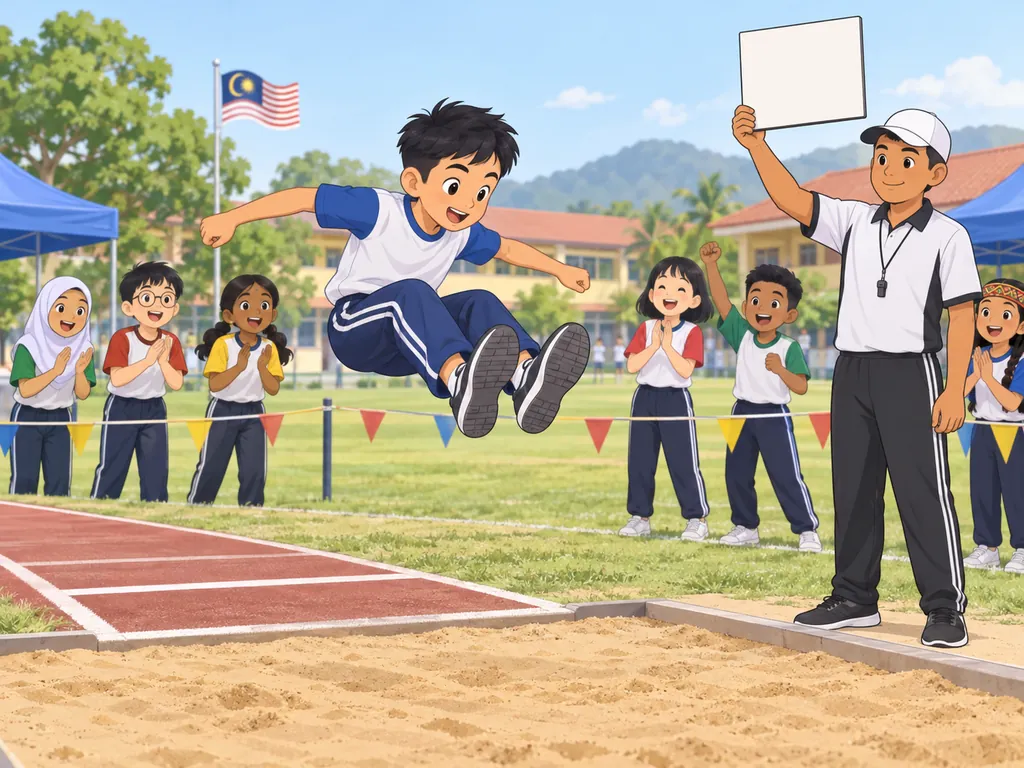
图意:学校运动会的跳远比赛
- 阿杰站在跑道起点,双手握拳,眼睛紧紧盯着前方的踏板。
- 他快速奔跑,用力一蹬,身体腾空,双脚向前伸。
- 他稳稳落在沙池里,裁判举起写着“4.10 米”的牌子,同学们在旁边拍手欢呼。
字数: 不少于 60 字
gerak-geri dan riak wajah = 动作和神态
Perenggan ini mesti menggambarkan dua perkara: perbuatan Ah Jie dari awal hingga akhir lompatan, dan riak wajahnya. Gunakan kata kerja yang tepat seperti berlari, menghentak dan mendarat. Kemudian huraikan wajahnya, misalnya bibir diketap rapat, mata merenung ke hadapan dan senyuman lebar selepas berjaya.
Contoh: Ah Jie mengetap bibir, lalu memecut ke arah papan lonjak.
Awas: Jangan hanya menyenaraikan perkara dalam gambar; tulis secara berurutan.
actions and expressions = 动作和神态
This paragraph must describe two things: what Ah Jie does from the start to the end of his jump, and the expressions on his face. Use precise action verbs such as sprint, push off and land. Then describe his face, for example lips pressed tight, eyes fixed ahead and a wide smile after his success.
Example: Ah Jie presses his lips together and sprints towards the board.
Watch out: Do not just list what is in the picture; write the actions in order.