确定数列的规律
学习比较相邻的数,找出重复出现的加、减、乘或除规律,并用规律确定下一项。
按下按钮才会播放语音,页面不会自动播放。
一眼看懂四种规律
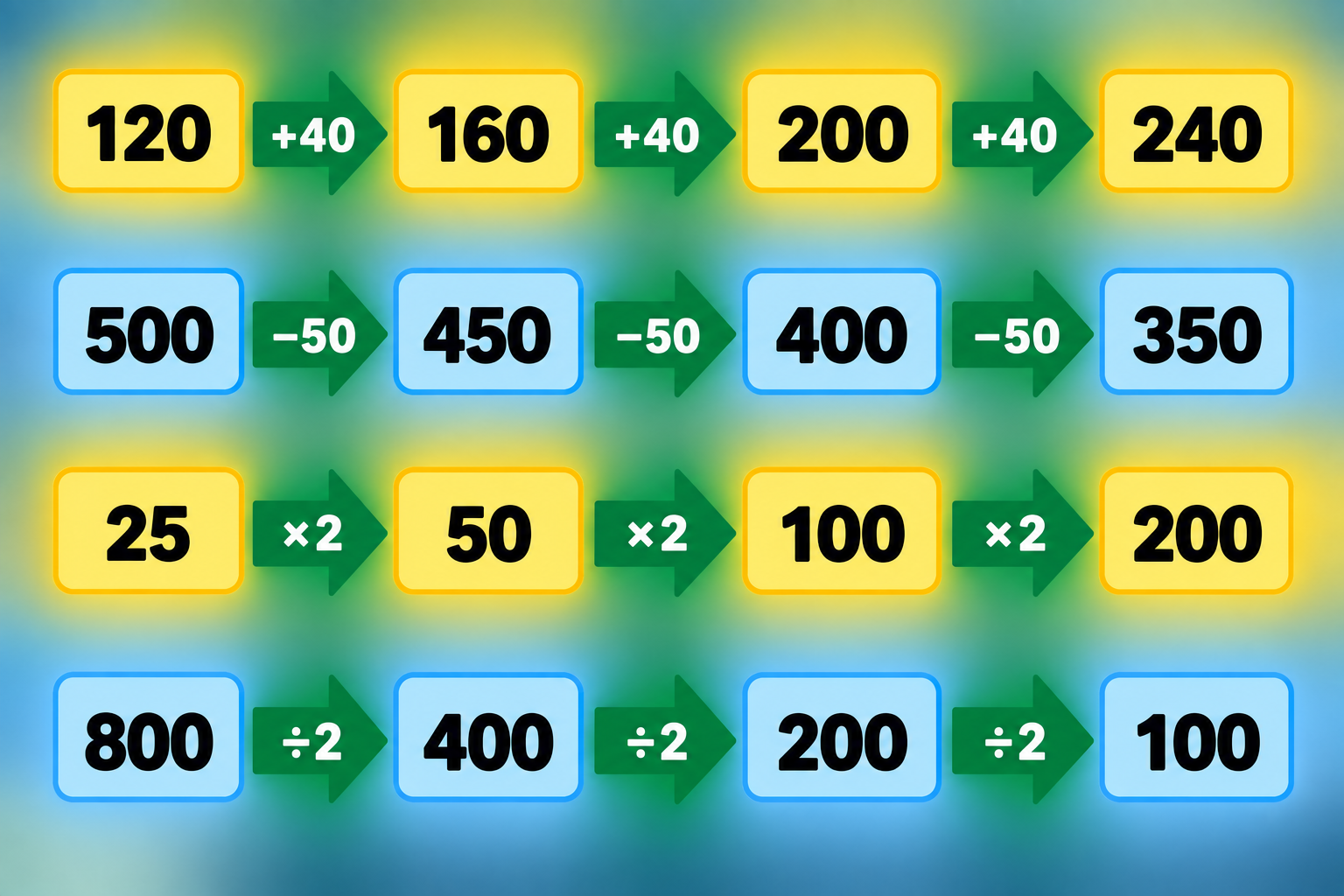
先找变化方向,再验证规律
先判断数列越来越大还是越来越小,再比较第一项和第二项。找到可能的运算后,必须用第二项到第三项再验证一次。
每次增加 40 000,所以规律是重复加 40 000。
找规律 = mencari pola
Tentukan dahulu sama ada nombor semakin besar atau semakin kecil. Kemudian cari beza antara sebutan pertama dan kedua: 360 000 − 320 000 = 40 000. Uji semula dengan sebutan kedua dan ketiga sebelum menetapkan pola.
Contoh: 950 000, 900 000, 850 000 semakin kecil. Beza 950 000 − 900 000 = 50 000, dan 900 000 − 850 000 juga 50 000, jadi polanya tolak 50 000.
Awas: Jangan buat kesimpulan daripada satu pasangan sahaja. 10 000, 20 000, 40 000 nampak seperti tambah 10 000 pada mulanya, tetapi sebenarnya darab 2.
找规律 = finding a pattern
First decide whether the numbers grow or shrink. Next find the gap between the first two terms: 360 000 − 320 000 = 40 000. Test it again on the second and third terms before you settle on the rule.
Example: 950 000, 900 000, 850 000 is shrinking. The gap 950 000 − 900 000 = 50 000 and 900 000 − 850 000 is also 50 000, so the rule is subtract 50 000.
Watch out: Never decide from one pair alone. 10 000, 20 000, 40 000 looks like add 10 000 at first, but it is really multiply by 2.
固定增加或固定减少
如果每一对相邻数目的差都相同,这个数列就是重复加上或减去同一个数。
加减规律 = pola tambah dan tolak
Jika beza setiap pasangan nombor bersebelahan sama, pola itu menambah atau menolak nombor yang sama. Tolak nombor yang lebih kecil daripada yang lebih besar untuk mendapat beza, kemudian lihat arah urutan.
Contoh: 2 600 000, 2 480 000, 2 360 000: setiap beza ialah 120 000 dan nombor semakin kecil, jadi polanya tolak 120 000.
Awas: Susun nilai tempat dengan betul semasa menolak. 1 325 000 − 1 250 000 = 75 000, bukan 750 000.
加减规律 = add or subtract pattern
When every pair of neighbouring numbers has the same difference, the sequence adds or subtracts that number each time. Take the smaller from the larger to get the difference, then check the direction of the list.
Example: 2 600 000, 2 480 000, 2 360 000: each difference is 120 000 and the numbers fall, so the rule is subtract 120 000.
Watch out: Line up the place values when subtracting. 1 325 000 − 1 250 000 = 75 000, not 750 000.
固定乘上或除以同一个数
有些数列的差不相同,但每一项都是前一项的固定倍数。可以用乘法或除法检查。
乘除规律 = pola darab dan bahagi
Jika beza antara sebutan tidak sama, cuba bahagi sebutan kedua dengan sebutan pertama. Jika hasil bahaginya sama untuk setiap pasangan, setiap sebutan ialah gandaan tetap sebutan sebelumnya.
Contoh: 30 000, 90 000, 270 000: 90 000 ÷ 30 000 = 3 dan 270 000 ÷ 90 000 = 3, jadi polanya darab 3.
Awas: Beza 60 000 dan 180 000 tidak sama, jadi pola ini bukan tambah. Jangan paksa pola tambah apabila bezanya berubah.
乘除规律 = multiply or divide pattern
If the differences are not equal, try dividing the second term by the first. When that quotient is the same for every pair, each term is a fixed multiple of the one before it.
Example: 30 000, 90 000, 270 000: 90 000 ÷ 30 000 = 3 and 270 000 ÷ 90 000 = 3, so the rule is multiply by 3.
Watch out: The gaps 60 000 and 180 000 are different, so this is not an adding pattern. Do not force an add rule when the gaps change.
即时理解检查 1
2 450 000,2 550 000,2 650 000,?
下一项 = sebutan seterusnya
Bandingkan 2 450 000 dengan 2 550 000, kemudian 2 550 000 dengan 2 650 000. Jika kedua-dua beza sama, tambah beza itu sekali lagi kepada sebutan terakhir untuk mendapat nombor yang hilang.
Contoh: 1 380 000, 1 410 000, 1 440 000 bertambah 30 000 setiap kali, jadi sebutan seterusnya ialah 1 470 000.
Awas: Tambah kepada sebutan terakhir, bukan sebutan pertama. Perhatikan digit ratus ribu yang berubah, bukan digit puluh ribu.
下一项 = next term
Compare 2 450 000 with 2 550 000, then 2 550 000 with 2 650 000. If both gaps match, add that gap once more to the last term to find the missing number.
Example: 1 380 000, 1 410 000, 1 440 000 grows by 30 000 each time, so the next term is 1 470 000.
Watch out: Add to the last term, not the first. Notice that it is the hundred-thousands digit that changes here, not the ten-thousands digit.
即时理解检查 2
6 400 000,3 200 000,1 600 000,?
除法规律 = pola bahagi
Beza antara sebutan ialah 3 200 000 dan kemudian 1 600 000, jadi bezanya tidak tetap. Cuba bahagi: 6 400 000 ÷ 3 200 000, kemudian 3 200 000 ÷ 1 600 000. Gunakan pembahagi yang sama pada sebutan terakhir.
Contoh: 8 100 000, 2 700 000, 900 000: setiap sebutan dibahagi 3, jadi sebutan seterusnya ialah 300 000.
Awas: Jangan tolak beza yang sama sekali lagi. Pola ini bukan tolak tetap, jadi beza setiap pasangan semakin kecil.
除法规律 = dividing pattern
The gaps are 3 200 000 and then 1 600 000, so the difference is not fixed. Try dividing: 6 400 000 ÷ 3 200 000, then 3 200 000 ÷ 1 600 000. Apply the same divisor to the last term.
Example: 8 100 000, 2 700 000, 900 000: each term is divided by 3, so the next term is 300 000.
Watch out: Do not subtract the same gap again. This is not a fixed-subtraction pattern, so the gaps keep shrinking.
本课小结
- 先判断数列是变大还是变小。
- 比较相邻两项,尝试固定加、减、乘或除。
- 至少用三项验证同一个规律,再确定下一项。