月食与日食都和光与影子有关
太阳是光源,地球和月球都是不透明体。当三个天体接近排成一直线时,其中一个天体会阻挡太阳光并形成影子。观察者处在不同位置,会看见不同程度的遮挡。
月食与日食 = gerhana Bulan dan gerhana Matahari
Kedua-dua gerhana berlaku apabila kedudukan Matahari, Bumi, dan Bulan menyebabkan cahaya Matahari dihalang. Bumi serta Bulan ialah objek legap yang membentuk bayang-bayang. Pemerhati di lokasi berbeza mungkin melihat tahap gerhana yang berlainan.
Contoh: Lampu suluh, bola, dan skrin boleh menunjukkan bagaimana objek legap menghasilkan bayang-bayang apabila berada pada satu garisan.
lunar and solar eclipses = 月食与日食
Both eclipses occur when the positions of the Sun, Earth, and Moon cause sunlight to be blocked. Earth and the Moon are opaque objects that produce shadows. Observers in different places may see different amounts of the eclipse.
Example: A torch, ball, and screen can show how an opaque object casts a shadow when the objects line up.
光沿直线传播,不透明体后方会形成影子
光从太阳向外沿直线传播,不能穿过地球或月球这样的不透明天体。完全照不到直射光的区域是本影区;只被遮住部分直射光的区域是半影区。影区的位置决定全食或偏食。
本影与半影 = umbra dan penumbra
Cahaya bergerak lurus dan tidak menembusi objek legap. Umbra ialah kawasan yang tidak menerima cahaya terus, manakala penumbra masih menerima sebahagian cahaya. Kedudukan pemerhati atau Bulan dalam kawasan ini menentukan sama ada gerhana penuh atau separa dilihat.
Contoh: Bayang paling gelap di belakang bola mewakili umbra, manakala bahagian yang lebih cerah di sekelilingnya mewakili penumbra.
umbra and penumbra = 本影与半影
Light travels in straight lines and does not pass through an opaque object. The umbra receives no direct light, while the penumbra still receives some. An observer’s or the Moon’s position in these regions determines whether a total or partial eclipse is seen.
Example: The darkest shadow behind a ball represents the umbra, while the lighter surrounding shadow represents the penumbra.
月食形成时,地球位于太阳和月球之间
月食发生在满月附近。太阳、地球和月球接近排成一直线,地球阻挡原本照向月球的阳光,月球进入地球的影子。从地球的黑夜一侧观察,月球会逐渐变暗。满月大约在农历十五或十六出现,所以月食也多在这几天发生。
月食排列 = susunan gerhana Bulan
Gerhana Bulan berlaku apabila Bumi berada di antara Matahari dan Bulan. Bumi menghalang cahaya Matahari daripada sampai terus ke Bulan, lalu Bulan memasuki bayang-bayang Bumi. Fenomena ini berlaku berhampiran fasa Bulan purnama.
Contoh: Ingat susunannya sebagai Matahari, Bumi, kemudian Bulan; objek di tengah ialah Bumi.
lunar-eclipse alignment = 月食排列
A lunar eclipse occurs when Earth is between the Sun and the Moon. Earth blocks sunlight from reaching the Moon directly, so the Moon enters Earth’s shadow. This happens near the full-moon phase.
Example: Remember the order as Sun, Earth, then Moon; Earth is the object in the middle.
月球进入不同影区会形成三种月食
整个月球进入地球本影时形成月全食;只有部分月球进入本影时形成月偏食;月球只进入半影时形成半影月食,亮度只轻微减弱。判断类型要看月球进入哪一个影区及进入多少。
月食种类 = jenis gerhana Bulan
Gerhana Bulan penuh berlaku apabila seluruh Bulan berada dalam umbra Bumi. Gerhana Bulan separa berlaku apabila hanya sebahagian Bulan memasuki umbra. Gerhana penumbra berlaku apabila Bulan hanya melalui penumbra dan kecerahannya berkurang sedikit.
Contoh: Jika hanya separuh Bulan memasuki umbra, fenomena itu ialah gerhana Bulan separa.
types of lunar eclipse = 月食种类
A total lunar eclipse occurs when the whole Moon enters Earth’s umbra. A partial lunar eclipse occurs when only part enters the umbra. A penumbral eclipse occurs when the Moon passes only through the penumbra and dims slightly.
Example: If only half of the Moon enters the umbra, the event is a partial lunar eclipse.
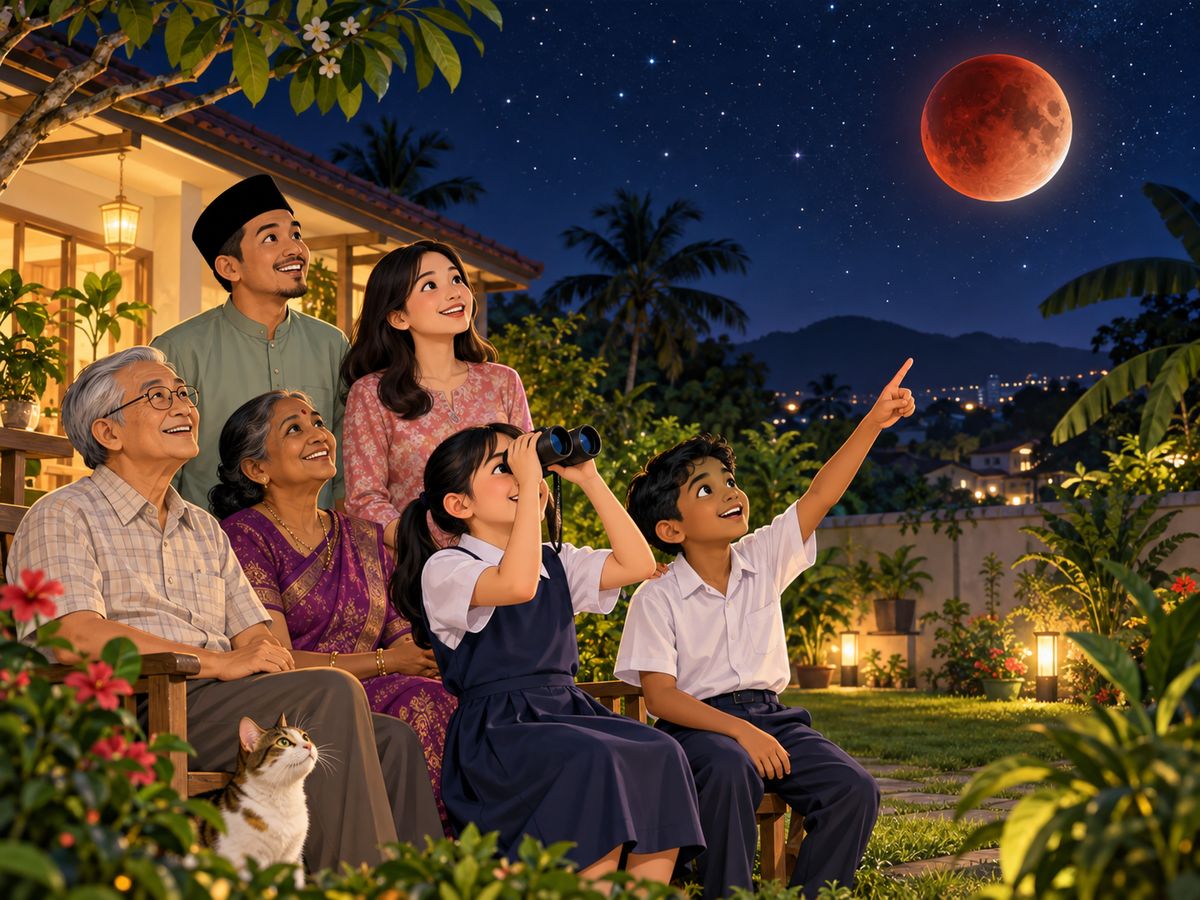
月全食时月球可能呈现暗红色
月全食期间,地球大气层会把部分太阳光弯曲到本影内,同时较短波长的光较多被散射,较多红橙色光到达月球并反射回地球。因此月球不是完全消失,而可能呈暗红或铜色。
红月亮 = Bulan merah
Semasa gerhana Bulan penuh, atmosfera Bumi membengkokkan sebahagian cahaya Matahari ke dalam umbra. Cahaya berpanjang gelombang pendek lebih banyak diserakkan, lalu lebih banyak cahaya merah jingga sampai ke Bulan dan dipantulkan ke Bumi.
Contoh: Warna jingga kemerahan ketika matahari terbenam juga berkaitan dengan penyerakan cahaya dalam atmosfera.
red Moon = 红月亮
During a total lunar eclipse, Earth’s atmosphere scatters and refracts some sunlight into the umbra. Shorter wavelengths are scattered more strongly, so more red-orange light reaches the Moon and is reflected back to Earth.
Example: The orange-red colour of a sunset is also related to the scattering of light in the atmosphere.
不是每次满月都会发生月食
月球绕地球的轨道相对于地球绕太阳的轨道约倾斜五度。多数满月时,月球会从地球影子的上方或下方经过;只有满月接近轨道交点并且三个天体接近直线排列时,才会发生月食。
轨道倾斜 = kecondongan orbit
Orbit Bulan condong kira-kira lima darjah berbanding satah orbit Bumi mengelilingi Matahari. Pada kebanyakan Bulan purnama, Bulan melalui bahagian atas atau bawah bayang-bayang Bumi. Gerhana hanya berlaku apabila penjajaran berlaku berhampiran titik persilangan orbit.
Contoh: Bulan purnama tanpa kedudukan sebaris tidak menghasilkan gerhana Bulan.
orbital tilt = 轨道倾斜
The Moon’s orbit is tilted by about five degrees relative to Earth’s orbital plane around the Sun. During most full moons, the Moon passes above or below Earth’s shadow. An eclipse occurs only when alignment happens near an orbital crossing point.
Example: A full moon without the required alignment does not produce a lunar eclipse.
月食模型要控制位置并安全观察
可在暗室用固定手电筒代表太阳、大球代表地球、小球代表月球。保持三者中心高度相近,慢慢移动“月球”,观察它进入半影和本影的次序。模型只用来说明光影关系,不代表真实大小与距离。
月食模型 = model gerhana Bulan
Gunakan lampu suluh tetap sebagai Matahari, bola besar sebagai Bumi, dan bola kecil sebagai Bulan. Samakan aras pusat objek dan gerakkan Bulan secara perlahan. Model menerangkan hubungan cahaya dan bayang-bayang, bukan saiz atau jarak sebenar.
Contoh: Kekalkan lampu dan Bumi, kemudian ubah kedudukan Bulan sahaja untuk melihat perubahan bayang-bayang.
Awas: Jangan gunakan cahaya yang terlalu kuat atau halakan lampu ke mata.
lunar-eclipse model = 月食模型
Use a fixed torch as the Sun, a large ball as Earth, and a small ball as the Moon. Keep their centres at similar heights and move the Moon slowly. The model explains light and shadow, not actual sizes or distances.
Example: Keep the light and Earth fixed, then change only the Moon’s position to observe shadow changes.
Watch out: Do not use an excessively bright light or point it at anyone’s eyes.
日食形成时,月球位于太阳和地球之间
日食发生在新月附近。太阳、月球和地球接近排成一直线,月球阻挡部分或全部阳光,月球的影子落在地球表面。只有位于影区内的地区才能看见日食。新月大约在农历初一出现,所以日食多在农历初一前后发生。
日食排列 = susunan gerhana Matahari
Gerhana Matahari berlaku apabila Bulan berada di antara Matahari dan Bumi. Bulan menghalang sebahagian atau seluruh cahaya Matahari lalu bayang-bayangnya jatuh pada permukaan Bumi. Fenomena ini berlaku berhampiran fasa anak Bulan.
Contoh: Ingat susunannya sebagai Matahari, Bulan, kemudian Bumi; objek di tengah ialah Bulan.
solar-eclipse alignment = 日食排列
A solar eclipse occurs when the Moon is between the Sun and Earth. The Moon blocks some or all sunlight, so its shadow falls on Earth’s surface. This happens near the new-moon phase.
Example: Remember the order as Sun, Moon, then Earth; the Moon is the object in the middle.
日全食和日偏食取决于观察地点所在影区
位于月球本影覆盖地区的观察者会看见太阳被完全遮住,形成日全食;位于半影覆盖地区的观察者只看见太阳部分被遮住,形成日偏食。影区之外的地区不会看见日食。
日食可见区 = kawasan gerhana Matahari
Pemerhati dalam umbra Bulan melihat gerhana Matahari penuh kerana cakera Matahari terlindung sepenuhnya. Pemerhati dalam penumbra melihat gerhana separa. Kawasan di luar kedua-dua bayang-bayang tidak melihat gerhana pada masa itu.
Contoh: Dua bandar boleh melihat jenis gerhana yang berbeza kerana berada dalam kawasan bayang-bayang yang berlainan.
solar-eclipse viewing region = 日食可见区
Observers in the Moon’s umbra see a total solar eclipse because the Sun’s disk is fully covered. Observers in the penumbra see a partial eclipse. Places outside both shadow regions do not see an eclipse at that time.
Example: Two cities can see different eclipse types because they lie in different shadow regions.
日环食发生时,月球看起来不足以遮住整个太阳
当月球离地球较远时,它在天空中看起来较小。即使太阳、月球和地球接近排成直线,月球仍不能完全遮住太阳,太阳边缘会形成明亮的环。这种现象叫日环食。日全食的全食阶段很短,最长也不超过约 7.5 分钟;月全食的全食阶段却可以超过一个小时。
日环食 = gerhana Matahari cincin
Gerhana Matahari cincin berlaku apabila Bulan kelihatan lebih kecil kerana berada lebih jauh dari Bumi. Bulan menutup bahagian tengah Matahari tetapi meninggalkan gelang cahaya yang terang. Gelang itu masih merupakan permukaan Matahari yang sangat terang.
Contoh: Bentuk cincin bukan tanda bahawa selamat memandang Matahari tanpa perlindungan khas.
Awas: Cermin mata hitam biasa tidak melindungi mata semasa gerhana.
annular solar eclipse = 日环食
An annular solar eclipse occurs when the Moon appears smaller because it is farther from Earth. The Moon covers the centre of the Sun but leaves a bright ring. That ring is still an intensely bright part of the Sun.
Example: The ring shape does not make it safe to look at the Sun without special protection.
Watch out: Ordinary sunglasses do not protect your eyes during an eclipse.
日全食的影区小,地球上的变化通常很短暂
月球比地球小,落在地球表面的本影范围也较小,并会随天体运动快速移动。因此日全食通常只在狭窄地区持续数分钟。太阳完全被遮住时天色会转暗,可能看见日冕和较明亮的星体。
日冕与短暂变化 = korona dan perubahan singkat
Umbra Bulan pada permukaan Bumi adalah kecil dan bergerak mengikut pergerakan relatif objek angkasa. Oleh itu, gerhana Matahari penuh hanya berlangsung singkat di sesuatu tempat. Ketika Matahari terlindung sepenuhnya, korona dan objek langit yang terang mungkin kelihatan.
Contoh: Bandar pada laluan umbra menjadi gelap seketika, manakala bandar berdekatan mungkin melihat gerhana separa.
corona and brief changes = 日冕与短暂变化
The Moon’s umbra on Earth is small and moves with the relative motion of the celestial bodies. Therefore, totality lasts only briefly at one location. When the Sun is fully covered, the corona and bright objects in the sky may become visible.
Example: A city in the umbra briefly darkens, while a nearby city may see only a partial eclipse.
任何时候观测太阳都必须保护眼睛
除非由专业人员确认并指导,学生不可直接望向太阳或日食。普通太阳眼镜、相机、手机、望远镜和自制滤片都不能作为安全保护。应由成人使用合格太阳观测镜,或采用背向太阳的针孔投影等间接方法。
日食观测安全 = keselamatan melihat gerhana
Jangan pandang Matahari secara terus tanpa pelindung suria khas dan pengawasan orang dewasa. Cermin mata hitam, kamera, telefon, teleskop, atau penapis buatan sendiri tidak selamat. Kaedah unjuran tidak langsung membolehkan imej diperhatikan tanpa menghadap Matahari.
Contoh: Berdiri membelakangi Matahari dan lihat imej yang dipancarkan oleh projektor lubang jarum pada kertas putih.
Awas: Jangan melihat Matahari melalui lubang jarum, kamera, binokular, atau teleskop.
solar-eclipse viewing safety = 日食观测安全
Never look directly at the Sun without special solar protection and adult supervision. Sunglasses, cameras, phones, telescopes, and homemade filters are unsafe. An indirect projection method lets students observe an image without facing the Sun.
Example: Stand with your back to the Sun and observe the image projected by a pinhole viewer onto white paper.
Watch out: Never look at the Sun through a pinhole, camera, binoculars, or telescope.
安全日食模型只模拟遮挡,不直接使用太阳
在室内用有扩散罩的灯代表太阳、小圆片代表月球、白屏代表地球。固定灯和屏幕,只改变圆片距离,记录影子大小与清晰度。学生模型用于学习排列和影区,不用于真实太阳观测。
安全日食模型 = model gerhana Matahari yang selamat
Gunakan lampu bertutup resap sebagai Matahari, cakera kecil sebagai Bulan, dan skrin putih sebagai Bumi. Kekalkan lampu serta skrin, kemudian ubah jarak cakera. Aktiviti ini mengkaji susunan dan bayang-bayang tanpa melihat Matahari sebenar.
Contoh: Gerakkan cakera lebih dekat kepada skrin dan rekod perubahan saiz serta ketajaman bayang-bayang.
safe solar-eclipse model = 安全日食模型
Use a diffused lamp as the Sun, a small disk as the Moon, and a white screen as Earth. Keep the lamp and screen fixed, then change the disk’s distance. This investigates alignment and shadows without viewing the real Sun.
Example: Move the disk closer to the screen and record changes in shadow size and sharpness.
比较月食与日食要看排列、月相、影子和可见范围
月食的顺序是太阳—地球—月球,发生在满月附近,月球进入地球影子,地球黑夜一侧较广地区可见;日食是太阳—月球—地球,发生在新月附近,月球影子落在地球,只在较小影区可见。两者都和光沿直线传播有关。
比较两种食现象 = membandingkan dua gerhana
Bandingkan objek di tengah, fasa Bulan, pemilik bayang-bayang, dan kawasan yang boleh melihat fenomena. Dalam gerhana Bulan, Bumi berada di tengah. Dalam gerhana Matahari, Bulan berada di tengah. Kedua-duanya melibatkan cahaya yang bergerak lurus.
Contoh: Tulis objek di tengah dahulu, kemudian nyatakan bayang-bayang siapa jatuh pada objek yang lain.
comparing the two eclipses = 比较两种食现象
Compare the middle object, Moon phase, source of the shadow, and viewing area. Earth is in the middle during a lunar eclipse, while the Moon is in the middle during a solar eclipse. Both involve light travelling in straight lines.
Example: Write the middle object first, then state whose shadow falls on the other object.
观察到月球进入地球本影,而且太阳、地球、月球接近排成一直线。这是什么现象?
辨认食现象 = mengenal pasti gerhana
Soalan memberikan dua petunjuk: Bulan memasuki bayang-bayang Bumi dan Bumi berada di tengah susunan. Kenal pasti pemilik bayang-bayang dahulu, kemudian tentukan jenis fenomena. Jangan hanya bergantung pada perkataan “Bulan” dalam ayat.
Contoh: Lakar tiga bulatan mengikut susunan yang diberikan dan tandakan arah cahaya.
identifying an eclipse = 辨认食现象
The question provides two clues: the Moon enters Earth’s shadow, and Earth is the middle object. Identify whose shadow is involved before naming the phenomenon. Do not choose only because the word “Moon” appears in the sentence.
Example: Sketch three circles in the stated order and mark the direction of sunlight.
用位置和影子解释食现象
你已能根据天体排列、光的直线传播和观察地点,解释月食与日食,并遵守安全观测规则。
开始加强练习 →日月食总结 = ringkasan gerhana
Gerhana terbentuk apabila cahaya Matahari yang bergerak lurus dihalang oleh objek legap. Gerhana Bulan melibatkan Bumi di tengah dan bayang-bayang Bumi pada Bulan. Gerhana Matahari melibatkan Bulan di tengah dan bayang-bayang Bulan pada Bumi.
Contoh: Nyatakan objek di tengah, kawasan bayang-bayang, fasa Bulan, dan lokasi pemerhati ketika menerangkan sesuatu gerhana.
eclipse summary = 日月食总结
Eclipses form when straight-travelling sunlight is blocked by an opaque object. A lunar eclipse has Earth in the middle and Earth’s shadow on the Moon. A solar eclipse has the Moon in the middle and the Moon’s shadow on Earth.
Example: Name the middle object, shadow region, Moon phase, and observer location when explaining an eclipse.