Keluarga Bahagia Hidup Ceria
Kita belajar mendengar dengan teliti, mentafsir bahan ringkas, menulis puisi dalam tulisan berangkai, bertutur dengan santun dan memilih kata nama yang tepat.
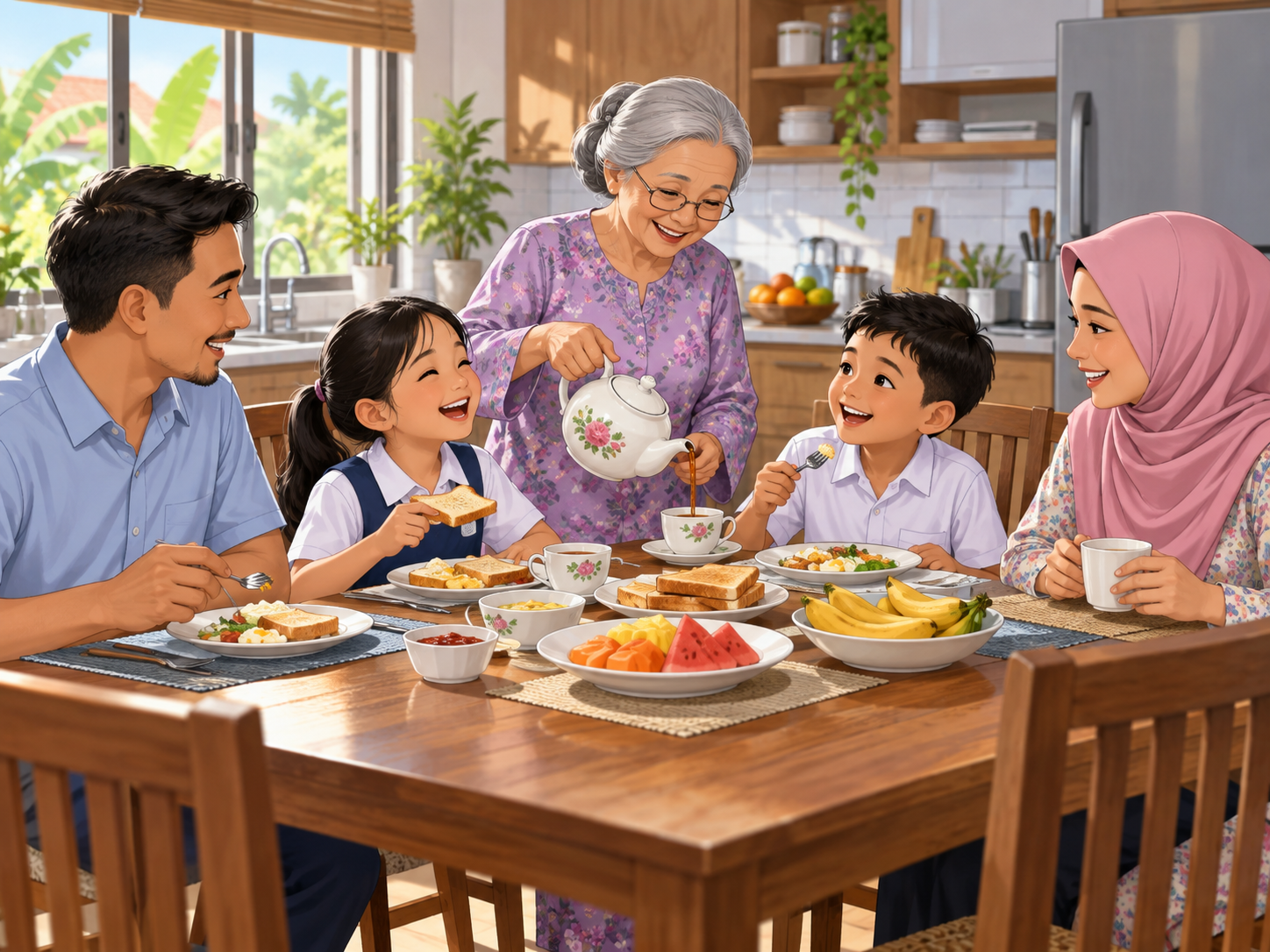
keluarga bahagia = 幸福家庭
本单元把听、读、写、说和语法连起来练习。先听清楚说话人的语气与目的,再从短文找出重点,最后用礼貌的语言表达自己的想法。
例子: 听到家人提醒整理书包时,先重复重点,再说明自己会怎样做。
keluarga bahagia = happy family
This unit joins listening, reading, writing, speaking, and grammar. Listen for the speaker’s tone and purpose, locate the main idea in a short text, and respond politely. Every activity uses a new family situation so that you practise the same language skill.
Example: When a family member reminds you to pack your bag, repeat the key message and state what you will do.
Dengar, Cam dan Sebut Semula
Apabila mendengar ujaran, kenal pasti siapa yang bercakap, perkara penting dan nada suara. Sebut semula maksud dengan ayat sendiri tanpa mengubah pesanan.
sebut semula = 复述
复述不是逐字背诵,而是保留人物、行动和时间等关键信息。先判断谁在说话,再找出对方要求或劝告的重点,最后用自己的句子说出来。语气也能帮助你分辨这是提醒、请求还是建议。
例子: “哥哥,请在下雨前关窗。”可以复述为“家人请哥哥在下雨前把窗关好”。
sebut semula = restate
Restating does not mean memorising every word. Keep the important person, action, and time, then express the message in your own sentence. The speaker’s tone also helps you decide whether the utterance is a reminder, request, or advice.
Example: “Please close the window before it rains” can be restated as “The family asks the brother to close the window before the rain.”.
Tafsir Bahan Bacaan
Maklumat tersurat disebut terus. Maklumat tersirat perlu disimpulkan daripada tindakan, sebab atau kesan yang dinyatakan dalam teks.
tersurat / tersirat = 明示 / 隐含
明示信息可以直接在短文中找到;隐含信息则要根据人物的行动、原因或结果来推断。回答时先引用一个线索,再说明你的推论,这样解释才有根据。不要只凭个人感觉猜测。
例子: 艾娜和弟弟一起排家务表,说明他们愿意合作,让家务更有条理。
tersurat / tersirat = explicit / implied
Explicit information is stated directly, while implied information must be inferred from actions, reasons, or results. Give one clue from the short text before stating your interpretation. This makes the inference supported by evidence instead of being a personal guess.
Example: Aina and her brother prepare a chore schedule, implying that they cooperate to keep household work organised.
Tulis Puisi Secara Mekanis
Tulisan berangkai perlu jelas, sekata dan mudah dibaca. Salin puisi mengikut baris asal, jaga huruf besar serta tanda baca.
Kasih dijaga setiap waktu.
tulisan berangkai = 连笔书写
机械书写诗歌的重点是字形清楚、连接一致和版面整齐。抄写时保留原来的分行,并检查大写字母与标点。速度不是首要目标;先确保别人能轻松读懂你的字。
例子: 两行诗要分成两行书写,不应连成一个长句,也不要漏掉句末标点。
tulisan berangkai = cursive writing
Mechanical poetry writing focuses on clear letter forms, consistent joins, and neat spacing. Keep the original line breaks and check capital letters and punctuation. Speed is less important than legibility, because another reader should be able to read every word easily.
Example: Copy two lines of a poem on two separate lines and retain the punctuation at the end.
Bandingan Semacam dan Simpulan Bahasa
Bandingan semacam menggunakan kata seperti, bagai atau umpama untuk membandingkan sifat. Simpulan bahasa pula membawa makna kiasan yang tetap: lapang dada bermaksud berasa lega atau menerima dengan tenang; jejak bara menggambarkan usaha yang hampir-hampir gagal. Perumpamaan seperti bulan jatuh ke riba pula bermaksud mendapat keuntungan yang tidak disangka-sangka.
bandingan semacam / simpulan bahasa = 明喻 / 惯用语
明喻常用 seperti、bagai 或 umpama 把两种事物的特点作比较;惯用语的整体意思不能逐字解释。lapang dada 表示宽心或坦然接受,jejak bara 表示事情几乎不能成功,seperti bulan jatuh ke riba 带有比喻词 seperti,属于 perumpamaan,表示意外得到好处。选择时要把词义放回完整语境。做题时,先看有没有 seperti 等比喻词,再决定它属于哪一类熟语,最后把意思放回句子里检查是否通顺。
例子: “cantik seperti bidadari”以“如仙女般美丽”作比较;“lapang dada”不能解释成胸口宽阔。
bandingan semacam / simpulan bahasa = simile / idiomatic expression
A simile uses words such as seperti, bagai, or umpama to compare qualities. A simpulan bahasa has a fixed figurative meaning: lapang dada means relieved or accepting, and jejak bara suggests an effort that nearly fails. Seperti bulan jatuh ke riba uses seperti, so it is a perumpamaan meaning an unexpected benefit. Test each expression in its whole context.
Example: “Cantik seperti bidadari” makes a comparison, while “lapang dada” must not be interpreted word by word.
Kata Nama dalam Keluarga
Kata nama am menamakan benda atau orang secara umum. Kata nama khas mempunyai nama khusus. Kata ganti nama menggantikan nama, manakala penjodoh bilangan dipilih mengikut benda.
kata nama = 名词
普通名词指一般人物或事物,专有名词指特定名称;代词用来代替已经知道的人物名称。量词则要配合物品的形状或类别。专有名词的首字母要大写,代词也要符合说话对象。
例子: “Encik Ravi”是专有名词,“beliau”可代替他的名字,“sehelai selimut”使用合适量词。
kata nama = noun
A common noun names a general person or thing, while a proper noun identifies a specific name. A pronoun replaces a known name, and a classifier must match the object’s form or type. Proper nouns begin with capital letters, and pronouns must suit the person being referred to.
Example: “Encik Ravi” is a proper noun, “beliau” replaces the name, and “sehelai selimut” uses an appropriate classifier.
Tulis Perenggan daripada Peta Minda
Perenggan pendek bermula dengan ayat topik, diikuti dua atau tiga isi daripada peta minda, dan diakhiri dengan ayat penutup. Hubungkan isi dengan penanda wacana seperti Selain itu dan Oleh itu.
perenggan = 段落
短段落写作通常给一个思维导图,要求写成大约五十个词的一段。先写一句主题句点出题目,再把导图里的两三个要点各扩写成完整句子,用 Selain itu、Oleh itu 等连接词串起来,最后用一句话总结。只把要点词语排列出来,不能算一个段落。
例子: 导图写着 mengeratkan hubungan 和 gembira,就各写成一个完整句子,再加上开头句和结尾句。
perenggan = paragraph
In the short-paragraph task, a mind map gives two or three points and you write about fifty words. Begin with a topic sentence, expand each point into a complete sentence, link the sentences with discourse markers such as Selain itu and Oleh itu, and finish with a concluding sentence. A list of keywords is not a paragraph.
Example: If the map shows mengeratkan hubungan and gembira, write each as a full sentence and add an opening and a closing line.
Semak Cepat
Ibu berkata, “Mira, sila letakkan dua pinggan di atas meja.” Ayat manakah menyebut semula pesanan itu dengan tepat?
pesanan = 嘱咐
题目要你保留原话的关键信息来复述,不需要猜测额外行动。先找人物、动作、数量和地点,再比较每个选项是否全部吻合。选择不会增添或删去重要信息的一项。
例子: 原话提到“两个盘子”和“桌上”,复述时这两个重点都必须保留。
pesanan = message
The question asks you to restate the message without adding a new action. Identify the person, action, quantity, and place, then compare all options. Choose the sentence that keeps every important detail and does not introduce information that was never spoken.
Example: If the utterance mentions “two plates” and “on the table,” both details must remain in the restatement.
Sedia untuk Berlatih
Anda telah melalui lima kemahiran bahasa dan satu semakan kefahaman. Teruskan dengan latihan pengukuhan.
Buka latihan kendiri →rumusan ujaran = 复述总结
完成第一单元后,你应能保留人物、行动、数量和时间来准确复述。阅读时要用线索区分明示与隐含信息,写诗时注意连笔与分行,口语表达保持礼貌,名词和量词也必须配合。
例子: 复述“整理两本书”时,人物、动作与“两本”的数量都不能遗漏。
rumusan ujaran = restatement summary
After Unit 1, you should preserve the person, action, quantity, and time when restating an utterance. Use textual clues to separate explicit and implied meaning, keep cursive poetry neat, speak courteously, and match nouns with suitable classifiers.
Example: When restating an instruction to arrange two books, retain the person, action, and quantity.